Ramayana: The monkey Dvivida who disturbed Ravana at night, and Shri Rama’s strategy
Ramayana: The war of the Ramayana was not merely a conflict of weapons and arms, but also a great test of righteousness, morality, and discipline. The monkey army that Lord Rama formed with the help of Vanararaja Sugriva was not just a group of powerful warriors, but also included monkeys of diverse temperaments and natures. Some monkeys were extremely disciplined, while others were inherently mischievous and restless. Among these mischievous monkeys was the monkey Dwivida, whose story even compelled Ravana to consider seeking refuge with Lord Rama.
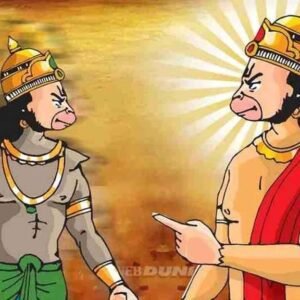
Formation and Discipline of the Monkey Army
The monkey army formed by Lord Rama was one of the most powerful armies of that era. This army included valiant warriors like Angada, Hanuman, Nala, and Neela. To control such a large and diverse army, a chief was appointed for each group, who was called a Yudhapati (commander of a troop). At that time, monkeys of the Kapi जाति (species) were prevalent, which are now extinct. These Kapis possessed extraordinary strength, speed, and courage, but they also had a fierce temperament, which was not easy to manage.
Introduction of Dwivida the Monkey
Dwivida, also called Dveeta in some texts, was the younger brother of Mainda, the minister of Vanararaja Sugriva. Both brothers possessed immense strength; it is said that they had the strength of ten thousand elephants. Besides being extremely powerful, Dwivida was also very mischievous by nature. He lived in a cave in Kishkindha with his brother Mainda. When Lord Rama formed the monkey army, Dwivida was also included in it due to his extraordinary strength.
The Story of Entering Lanka at Night
There were established rules of war between Rama and Ravana. The war took place during the day, and both armies rested after sunset. However, Dwivida did not care about these rules. He would secretly enter Lanka at night. At that time, Ravana was usually engrossed in the worship of Lord Shiva. Dwivid deliberately disrupted Ravana’s worship, which increased both Ravana’s anger and helplessness.
Ravana’s Complaint to Lord Rama
Ravana was extremely troubled by Dwivid’s behavior. During the day, he faced Lord Rama’s army in battle, but these nighttime antics were making him uneasy. Finally, Ravana complained directly to Lord Rama through a letter. He wrote that according to the rules of war, there is no fighting after sunset, so why was this monkey coming to Lanka at night and disrupting his Shiva worship? This was against the established norms, and he requested Lord Rama to restrain his monkey from such mischief.
Lord Rama’s Reaction and Wisdom
Upon reading Ravana’s letter, Lord Rama immediately asked Sugriva to find out who the monkey was. Lord Rama was omniscient, so he meditated and learned the truth himself. He discovered that Dwivid was responsible. Lord Rama summoned Dwivid and explained to him that it was not right to cause trouble in Lanka at night. He explained the importance of the rules and discipline of warfare.
Dwivid’s Stubbornness and the Decision
However, even after Lord Rama’s explanation, Dwivid did not change his ways. His aggressive and mischievous nature prevented him from adhering to the rules. Then Lord Rama made a difficult but just decision. He told Sugriva that Dwivid should no longer be included in the war and should be sent back to Kishkindha. This decision shows that for Lord Rama, Dharma (righteousness) and established norms were more important than victory.
The Lesson from the Story
This story of Dwivid teaches us that strength alone is not enough; discipline and adherence to rules are equally essential. Lord Rama made it clear that even if someone was on his side, if they violated the rules, they would face punishment or be distanced from him. This is why Lord Rama is still revered today as Maryada Purushottam (the ideal man who upholds righteousness).