The Legendary Slaying of Lavanasura: A Story of Dharma, Courage, and Justice
The Legendary Slaying of Lavanasura: The story of Lavanasura is one of the lesser-known yet deeply symbolic narratives from ancient Indian mythology. It represents the eternal conflict between righteousness and tyranny, where moral duty ultimately triumphs over cruelty and oppression. Lavanasura was a fearsome demon who ruled the dense forests near Madhuvan, close to the region that would later become Mathura. His reign of terror disrupted peace, endangered innocent lives, and challenged the balance of justice. The question of who killed Lavanasura is not merely historical or mythological; it reflects a deeper philosophical message rooted in dharma and leadership.
Who Was Lavanasura and Why Was He Feared
Lavanasura was known as the son of the powerful demon Madhu, a figure infamous for his cruelty and defiance of divine order. According to ancient texts, Madhu had been defeated and killed by Lord Vishnu due to his continuous acts of injustice. After his father’s death, Lavanasura inherited his kingdom and his aggressive nature. He established his dominance in the Madhuvan forest region, where he oppressed sages, villagers, and travelers without mercy.
The area that once flourished with natural beauty and spiritual activity slowly turned into a land of fear. Hermitages were destroyed, sacrifices were interrupted, and common people lived in constant terror. Lavanasura’s strength was believed to come from powerful boons and divine protections, making him nearly invincible to ordinary warriors.
The Origins and Background of Lavanasura
Lavanasura’s birth itself is surrounded by mystical elements. He was born to Madhu and the daughter of the sage Trinavindu. This connection gave him both demonic power and access to spiritual knowledge, which he later misused for personal dominance. Instead of following a balanced path, Lavanasura chose cruelty, using his strength to assert control rather than protect his people.
As his influence grew, so did his arrogance. He considered himself beyond punishment and believed no force could challenge his authority. This false sense of invincibility eventually became the reason for his downfall.
The Role of Shatrughna in the Conflict
The responsibility of ending Lavanasura’s terror fell upon Shatrughna, the youngest brother of Lord Rama and a prince of Ayodhya. Known for his bravery, discipline, and unwavering loyalty to dharma, Shatrughna was chosen for this mission due to his exceptional warrior skills and moral strength.
At the request of sage Vishwamitra, and with the blessings of Lord Rama, Shatrughna accepted the challenge of confronting Lavanasura. This was not merely a battle of weapons but a test of righteousness against unchecked power. Shatrughna prepared himself through discipline, divine blessings, and strategic planning before entering Madhuvan.
The Battle and Death of Lavanasura
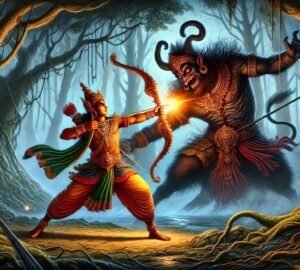
The confrontation between Shatrughna and Lavanasura was intense and decisive. Lavanasura relied heavily on his boons and supernatural powers, underestimating Shatrughna’s resolve. However, Shatrughna fought with clarity of purpose, using divine weapons granted to him and maintaining complete focus on his duty.
Through courage and divine support, Shatrughna successfully killed Lavanasura, bringing an end to his reign of terror. This victory symbolized the triumph of moral duty over arrogance and cruelty. The forest of Madhuvan was finally freed from fear, and peace was restored to the region.
Liberation and Transformation of Madhuvan
After Lavanasura’s death, Madhuvan underwent a remarkable transformation. What was once a land overshadowed by violence became a place of renewal and order. Shatrughna took responsibility for rebuilding the region, ensuring safety and stability for its inhabitants.
He later established a new city in the liberated land, which came to be known as Mathura. This city evolved into a major cultural, spiritual, and economic center, playing a significant role in later historical and religious traditions. The foundation of Mathura marked not only physical reconstruction but also the restoration of ethical governance.
Symbolic Meaning of the Story
The tale of Lavanasura’s death carries profound symbolic value. It teaches that unchecked power without moral responsibility leads to destruction. It also emphasizes that true leadership involves protecting the innocent and standing firmly against injustice, even when the opponent seems invincible.
Shatrughna’s actions demonstrate that courage guided by righteousness can overcome even the greatest threats. His victory serves as an enduring reminder that justice, patience, and duty are essential pillars of a balanced society.