Ramayana – Mandodari’s Wisdom and Role in Lanka’s Fate
Ramayana – The Ramayana stands as one of India’s most revered ancient epics, known not only for the journey of Lord Rama and Sita but also for its layered portrayal of complex and compelling characters. Among them, Mandodari, the queen of Lanka and wife of Ravana, occupies a place of quiet strength and moral clarity. Her presence in the narrative adds depth to the epic’s exploration of duty, loyalty, and righteousness.
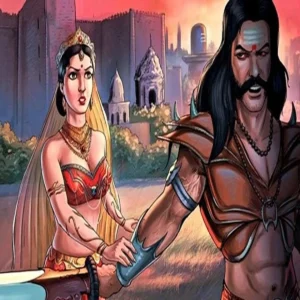
Mandodari’s Lineage and Early Life
According to traditional accounts, Mandodari was born to Mayasura, a master architect among the asuras, and the celestial nymph Hema. Raised in an environment associated with knowledge and refinement, she was known for her grace and intelligence from an early age. Her marriage to Ravana, the powerful ruler of Lanka, brought her into one of the most formidable royal households described in the Ramayana.


Ravana was celebrated for his scholarship and military prowess, yet his ambition and pride often led him toward destructive decisions. In contrast, Mandodari’s character is consistently depicted as thoughtful and ethically grounded. She is remembered not merely as a queen, but as a voice of reason within the palace of Lanka.
A Voice of Counsel in Times of Crisis
Throughout the Ramayana, Mandodari is portrayed as advising Ravana against actions that violated moral and social codes. When Ravana abducted Sita, she is said to have urged him to reconsider his decision and return her with honor. Her counsel was rooted in principles of dharma and foresight, warning that injustice would bring severe consequences.
Even after Hanuman’s entry into Lanka and the destruction that followed, Mandodari reportedly reminded Ravana of the growing threat he faced. She encouraged him to seek a peaceful resolution rather than pursue a path of confrontation. Despite her repeated efforts, Ravana remained steadfast in his course, driven by pride and determination.
Mandodari’s loyalty to her husband never wavered, even as she disagreed with his actions. This balance between personal devotion and moral conviction has often been cited as a defining aspect of her character.
Grief and Transition After Ravana’s Death
The death of Ravana marked a turning point for Lanka. With the kingdom in turmoil after the war, the need for political stability became urgent. Vibhishana, Ravana’s brother who had sided with Rama and later ascended the throne, was tasked with rebuilding the kingdom.
Several retellings of the Ramayana suggest that Mandodari later married Vibhishana. This union is generally interpreted not as a personal choice driven by emotion, but as a step toward restoring order and unity in Lanka. In the cultural and social context of the time, such alliances were often viewed as necessary for the welfare of the state.
The marriage symbolized continuity and reconciliation after conflict. By accepting this role, Mandodari once again demonstrated resilience and commitment to the larger good of her people.
An Enduring Symbol of Strength and Integrity
Mandodari’s legacy within the Ramayana extends beyond her identity as Ravana’s queen. She is frequently described as wise, composed, and deeply principled. Her ability to speak truth in the face of power, while maintaining dignity and loyalty, sets her apart as one of the epic’s most respected female figures.
Her story also reflects the broader themes embedded in ancient Indian literature—where personal sacrifice is often intertwined with social responsibility. In moments of crisis, Mandodari upheld her ethical beliefs, even when her words went unheeded.
For generations, her character has been interpreted as a representation of inner strength and moral courage. While the epic centers on the battle between Rama and Ravana, Mandodari’s journey quietly underscores the human cost of pride and conflict.
Through wisdom, restraint, and steadfast character, Mandodari continues to hold a significant place in discussions about the Ramayana and its portrayal of women in positions of influence. Her life within the epic serves as a reminder that guidance grounded in ethics remains relevant, even when overshadowed by power and ambition.