Ramayana Mythological Story: A Retelling of Ganga’s Celestial Journey
Ramayana Mythological Story: When Lord Vishnu incarnated as Shri Ram in the royal palace of Ayodhya, his childhood became a radiant tapestry of divine acts and profound teachings. At the age of sixteen, when Sage Vishwamitra arrived seeking protection for his sacred rites, Ram and Lakshman stepped forward with unwavering courage. As they journeyed through the forest, Vishwamitra narrated ancient tales meant to enrich their understanding of devotion, duty, and the mysteries of creation. Among these stories was the extraordinary journey of the celestial river who descended from heaven for the liberation of mankind. This is the timeless account of the river Ganga, as narrated to the young princes.
Origin of Ganga from the Feet of Vishnu
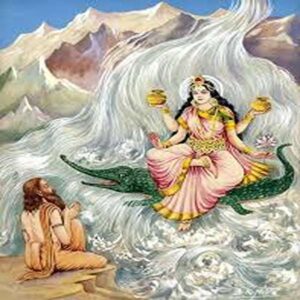
According to ancient tradition, Ganga was first known as Mandakini, the river of heaven residing in the vessel of Brahma. When Lord Vishnu appeared as Vamana and expanded into the cosmic form of Trivikrama, his foot pierced the upper realm of the universe. From this divine breach flowed a stream of pure, radiant water that became Ganga. Brahma gathered the celestial waters in his sacred vessel and established the heavenly river, honored as Vishnupadi, the one born from the feet of Vishnu.
The Fate of King Sagara’s Sons and the Vow of Bhagiratha
In the Ikshvaku lineage, King Sagara once performed a grand ritual that was disrupted when Indra hid the ceremonial horse in the hermitage of Sage Kapila. Sagara’s sixty thousand sons, driven by pride, stormed the hermitage and accused the sage of theft. Their reckless disturbance awakened Kapila from meditation, and with a single glance of fiery power, the princes were reduced to ashes. Without final rites, their souls remained bound, unable to attain peace.

Sagara’s descendants Anshuman and later Dilip attempted to find a way to liberate them. Ultimately, Prince Bhagiratha undertook a vow to bring the celestial river to earth so that the sacred waters could free his ancestors. His long and intense austerities in the Himalayas finally moved Brahma to grant his request.
The Warning of Brahma and the Austerity for Shiva
Brahma cautioned Bhagiratha that the force of Ganga’s descent would shatter the earth unless a divine being restrained her. Only Lord Shiva possessed the strength to receive her. Accepting this challenge, Bhagiratha traveled to Mount Kailash and immersed himself in another cycle of severe penance. Pleased by his devotion, Shiva agreed to bear the celestial river in his matted locks.
The Humbling of Ganga
When the news reached the heavens, Ganga felt a surge of pride, imagining that even Shiva would be unable to restrain her immense power. She descended with fierce momentum, but Shiva effortlessly captured her within his tangled locks. Trapped and unable to break free, Ganga realized the limits of her own strength.
The Release into Bindu Sarovar and the Seven Streams
Once again, Bhagiratha prayed, and Shiva responded by releasing a single stream of Ganga from his locks. As she fell upon the Himalayas, she divided into seven distinct currents. While six streams flowed eastward and westward, the seventh followed Bhagiratha, granting her the name Bhagirathi in honor of his determination.
The Anger of Sage Jahnu and the Name Jahnavi
During her journey, the river flooded the hermitage of Sage Jahnu, disrupting his sacred ritual. Angered, he drank the entire river in a single act. The gods pleaded for her release, and moved by their requests, Jahnu allowed Ganga to emerge from his ear. From this moment, she also became known as Jahnavi, the daughter of Jahnu.
Liberation of the Sons of Sagara
Following Bhagiratha, Ganga finally reached the subterranean realm where the ashes of Sagara’s sons lay. At the touch of her purifying waters, the souls of the princes were released from suffering and ascended to the heavenly realm. Thus, Ganga came to be celebrated in three worlds as Tripathaga, the river flowing through heaven, earth, and the underworld.