Temple – Ancient Hilltop Shrine of Kaiway Mata Draws Devotees Year Round
Temple – Perched atop a steep hill nearly 3,000 feet high, the historic Kaiway Mata Temple in Kinsariya village of Parbatsar region stands as a powerful symbol of faith for thousands of devotees. Pilgrims climb more than 1,150 stone steps to reach the shrine, where idols of Kaiway Mata and Chamunda Mata are worshipped. For generations, people have believed that the goddess manifested at this very spot to protect the surrounding land and its people. Over time, the temple has grown into an important spiritual center where devotees arrive seeking blessings and peace.
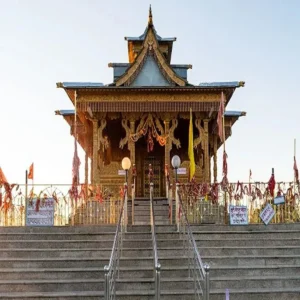
Historical Roots Traced Back Over a Thousand Years
According to temple priest Bhikam Das Sharma, the site carries remarkable historical significance. An inscription carved on the outer wall of the temple pavilion dates back to Vikram Samvat 1056, corresponding to 999 CE. The inscription states that the temple was constructed by Chachdev Dahiya, a ruler from the Dahiya dynasty who served as a feudal lord under the Chauhan king Durlabharaj of Sambhar.
Historical records suggest that the temple’s construction was completed on April 21, 999 CE, coinciding with the auspicious festival of Akshaya Tritiya. Over centuries, the shrine has continued to remain an important center of devotion, with successive rulers contributing to its development and preservation.
Royal Patronage and Expansion Over Time
Temple caretaker Girdhari Maharaj explained that the idol of Kaiway Mata was installed at this sacred location during the reign of the Chauhan rulers. The temple built in 999 CE later received further royal attention. In 1712, Maharaja Ajit Singh of Jodhpur arranged for the installation of an idol of Maa Bhavani inside the temple complex. This idol is positioned to the left side of the main Kaiway Mata shrine and continues to be worshipped by visitors.
Over time, the temple complex has been maintained and improved to accommodate the growing number of devotees. The site today reflects layers of history that stretch across more than a millennium.
Climbing the Hill to Reach the Sacred Shrine
The journey to the temple itself is an act of devotion for many pilgrims. Visitors must climb more than 1,150 steps carved along the hillside to reach the shrine at the summit. Despite the challenging ascent, devotees of all ages undertake the climb, often chanting prayers and hymns along the way.
To assist elderly visitors, a limited number of palanquins are available that help transport devotees up the hill. However, many pilgrims still prefer to complete the climb on foot as a mark of faith. Local authorities and temple management have also discussed plans to construct a ropeway in the near future. Once completed, the ropeway is expected to make access easier for elderly visitors and families traveling with children.
Sacred Statues and Surrounding Forest Area
At the entrance of the temple’s assembly hall stand two statues of Bhairav, locally known as Kala and Gora. These statues are regarded as guardians of the shrine and hold a special place in local traditions.
The temple is also surrounded by thousands of bighas of forest land, which locals refer to as “Mataji ka Oran.” This protected forest area has long been associated with the temple and is considered sacred by nearby communities.
Navratri Festival Brings Large Crowds
The temple witnesses its largest gatherings during the Navratri festival. During this period, the hilltop shrine becomes a center of devotion and celebration as thousands of pilgrims travel from different parts of Rajasthan and neighboring states.
According to temple priest Girdhari Maharaj, groups of devotees regularly arrive from Gujarat, Maharashtra, Uttar Pradesh and other regions. From early morning, the hills echo with chants and devotional songs as pilgrims climb toward the temple.
Devotee Vinod Gaur noted that the temple is believed to be more than a thousand years old and continues to draw visitors because of its deep cultural and spiritual importance. While facilities such as palanquins are available for elderly devotees, their cost means not everyone can use them. For many pilgrims, however, the climb itself remains part of their spiritual journey.