The Hidden Reason Behind Lord Rama’s Exile: A Forgotten Curse from the Past
The Hidden Reason Behind Lord Rama’s Exile: Lord Rama, the human incarnation of Lord Vishnu, descended on Earth to destroy evil and restore righteousness. The defeat of the demon king Ravana was not an ordinary event but a carefully woven divine plan. For this cosmic purpose to unfold, Lord Rama had to accept fourteen years of exile in the forest. This exile led to the journey toward Lanka, the abduction of Sita, the great war, and finally the death of Ravana. Although the immediate cause of this exile was Queen Kaikeyi’s two boons, the deeper reason lay hidden in King Dasharatha’s past. When Rama, Lakshmana, and Sita left Ayodhya, King Dasharatha was consumed by unbearable grief, a sorrow that soon pushed him toward death. In his final moments, he revealed to Queen Kaushalya that Rama’s exile was the result of an old, forgotten sin.
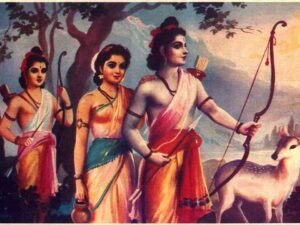
King Dasharatha’s Grief After Rama’s Departure
After Rama departed for the forest, King Dasharatha’s condition became deeply tragic. Separated from his beloved son, he fainted repeatedly and cried out in despair. When his charioteer Sumant returned after leaving Rama, Lakshmana, and Sita in the forest, the king’s sorrow intensified. He lamented that no pain in the world could equal the suffering of being separated from one’s child in old age. His palace echoed with grief, and his strength slowly faded away.
Kaushalya’s Harsh Words
Overwhelmed by sorrow, Queen Kaushalya spoke bitterly to the king. She questioned how Rama, Lakshmana, and especially Sita, who had lived their entire lives in royal comfort, would endure the hardships of the forest. She accused Dasharatha of cruelty and blamed him for sacrificing his eldest son’s happiness for the sake of Kaikeyi and Bharata. Her words, though born from pain, struck the king’s heart deeply and left him shattered.
A Change of Heart and a Confession
Seeing Dasharatha’s helpless condition, Kaushalya’s anger soon melted into compassion. She apologized, explaining that grief had clouded her judgment. She confessed that even five nights without Rama felt like five long years. At this moment, King Dasharatha spoke in a calm yet heavy voice and told her that everything happening was the result of his own past actions. He then began narrating a story from his youth.
A Fatal Mistake in the Forest
Dasharatha revealed that before his marriage, he once went hunting near the banks of the Sarayu River. At dusk, he heard a sound that resembled the roar of a wild elephant. Believing it to be his target, he released a powerful arrow guided only by sound. Moments later, he heard a human cry filled with pain. The realization struck him that he had made a terrible mistake.
The Death of Shravan Kumar
Rushing toward the sound, Dasharatha found a young ascetic lying wounded, with a water pot fallen beside him. The youth revealed that his name was Shravan Kumar and that he had come to fetch water for his blind and elderly parents. He begged the king to remove the arrow from his chest and to give water to his parents waiting nearby. After saying this, Shravan Kumar died, leaving Dasharatha trembling with remorse.
Dasharatha’s Deep Regret
Carrying the water pot, Dasharatha approached Shravan Kumar’s parents and confessed his sin. The blind couple, unaware at first, asked for their son. When they learned the truth, their cries were filled with unbearable pain. Though anger consumed them, they acknowledged the king’s honesty in confessing his crime.
The Curse That Shaped Destiny
Before giving up their lives, Shravan Kumar’s parents cursed Dasharatha, declaring that just as they were dying from the pain of losing their son, the king too would die in agony caused by separation from his son. After performing their son’s last rites, they entered the funeral pyre themselves. Dasharatha concluded that the curse had now come true, and Rama’s exile was the instrument through which destiny fulfilled that ancient judgment.
Conclusion
Thus, Lord Rama’s exile was not merely the result of palace politics or a queen’s demand, but the unfolding of karma and destiny. The ancient curse tied Dasharatha’s past to Rama’s future, proving that every action leaves an imprint on time. This story from the Ramayana highlights the profound connection between duty, consequence, and divine purpose.