Creator – Exploring the Mythological Origins and Significance of Lord Brahma
Creator – In Hindu belief systems, Lord Brahma is regarded as the architect of the universe and one of the three principal deities who govern cosmic functions. Alongside Vishnu, the preserver, and Shiva, the transformer, Brahma is entrusted with the responsibility of creation. While his role in shaping the universe is widely acknowledged, questions about his own origin have long intrigued scholars and devotees alike. Ancient scriptures, particularly the Shiva Purana, offer detailed narratives explaining how Brahma came into existence.
Mythological Account of Brahma’s Birth
According to traditional accounts, Brahma is believed to have emerged from a lotus that grew from the navel of Lord Vishnu, who was resting on the cosmic ocean known as Kshirsagar. This unique origin is why Brahma is often described as self-born. The imagery of the lotus signifies purity and divine creation, reinforcing his role as the creator of all living beings.
Another story mentioned in sacred texts provides a different perspective. It narrates a conversation between Brahma and his son Narada. In this account, Brahma explains that after Vishnu was brought into existence, Sadashiva and Shakti created him from their own being and placed him within the lotus arising from Vishnu’s navel. From that lotus, Brahma was born as a manifestation of divine intent. These layered interpretations highlight the symbolic depth of Hindu mythology, where creation is often described through interconnected divine actions.
Reason Behind the Name Brahma
The name Brahma is deeply rooted in Indian philosophical thought. It is derived from the concept of “Brahman,” which refers to the ultimate, formless, and all-pervading reality that exists beyond the three fundamental qualities of nature—sattva, rajas, and tamas. Since Brahma embodies aspects of this cosmic principle in the act of creation, he is identified with this name.
In various texts, Brahma is also addressed by several other titles such as Swayambhu, meaning self-existent, and Chaturanan, referring to his four faces. Each of these names reflects a particular attribute associated with his identity and cosmic role.
Symbolism Behind Brahma’s Four Faces
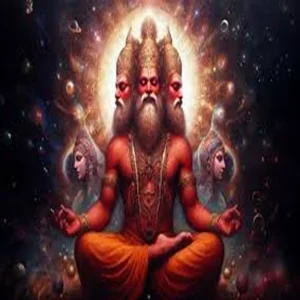
One of the most distinctive features of Brahma is his four heads. Mythological explanations suggest that when he first came into existence, he looked in all four directions to understand his surroundings. This act resulted in the formation of four faces, symbolizing his awareness and ability to oversee all aspects of creation. These four faces are also interpreted as representations of the four Vedas, indicating his association with knowledge and wisdom.
Key Attributes and Iconography
Brahma is typically depicted holding specific objects in his four hands, each carrying symbolic meaning. These include a rosary, representing time and continuity; the Vedas, symbolizing knowledge; a water pot, associated with creation; and a gesture of blessing, indicating benevolence. His vehicle is believed to be a swan, which signifies discernment and the ability to distinguish between truth and falsehood.
Family and Role in Creation
In traditional accounts, Brahma’s consort is Savitri, while Saraswati is often regarded as his daughter and the embodiment of knowledge and learning. It is believed that Brahma played a role in imparting the wisdom of the Vedas to Saraswati, enabling her to become the goddess of education and arts.
Brahma is also referred to as the grandfather of all beings, as many divine and earthly entities are said to have originated from him. This is why he is often called Pitamah, meaning the grandsire. His position in mythology emphasizes the idea that all life ultimately traces back to a single creative source.
Enduring Significance in Hindu Thought
Although Brahma is one of the central figures in Hindu cosmology, his worship is relatively limited compared to Vishnu and Shiva. Nevertheless, his role as the creator remains fundamental to understanding the broader framework of Hindu philosophy. The stories surrounding his origin not only explain his place in the divine hierarchy but also reflect deeper symbolic meanings about existence, knowledge, and the nature of creation itself.