Mythology – Ancient Tale of Garuda and Vishnu Reveals Devotion and Courage
Mythology – Stories from Indian mythology often carry layers of meaning that go beyond simple narration. Among these, the tale of Garuda and Lord Vishnu stands out as a powerful account of determination, sacrifice, and unwavering devotion. Though many are familiar with Vishnu’s ten incarnations, this lesser-discussed story offers a unique perspective on faith and duty.
Rivalry Between Sisters Shapes the Story
The origins of this tale begin with Sage Kashyap and his two wives, Vinata and Kadru, who were also sisters. Despite living under the same roof, the two shared a strained relationship marked by jealousy. Both longed for children, and Kashyap granted them a boon. Vinata wished for two strong sons, while Kadru asked for a thousand serpent offspring, all born from eggs.
Kadru’s wish was fulfilled first. Her thousand serpent sons emerged and began serving her faithfully. Meanwhile, Vinata’s eggs had yet to hatch. Growing impatient, she broke one of the eggs prematurely. From it emerged Aruna, only partially developed. His upper body resembled that of a human, but the lower part was incomplete.
A Curse Born from Impatience
Aruna, distressed by his incomplete form, blamed his mother for her lack of patience. He declared that Vinata would have to live in servitude as a consequence of her actions. He also added that only her second son could free her from this fate, if he was capable.
Frightened by the curse, Vinata waited patiently for the second egg to hatch. However, due to a bet between the sisters regarding whose children were superior, Vinata ultimately lost and was forced into servitude under Kadru.
Birth of Garuda and a Mission for Freedom
After a long wait, the second egg finally hatched, giving birth to Garuda. He was a magnificent being with a human-like body, the face of a bird, and enormous wings. Upon learning about his mother’s condition and the circumstances that led to her servitude, Garuda resolved to set her free.
He approached Kadru and the serpents to ask what would release his mother from bondage. They demanded a rare and powerful reward—the nectar of immortality, known as Amrit, which had emerged during the cosmic churning of the ocean.
A Perilous Journey to the Heavens
Determined to fulfill the condition, Garuda set out toward the heavens to obtain the Amrit. The task was far from simple. The nectar was heavily guarded by divine forces through multiple layers of protection.
The first barrier was a massive wall of fire. Garuda overcame it by carrying water from several rivers in his beak and extinguishing the flames. The next challenge involved rotating weapons that could destroy anything in their path. Garuda cleverly reduced his size, passing through unharmed. Finally, two deadly serpents guarded the nectar. He defeated them and seized the pot of Amrit.
Divine Encounter and Blessings
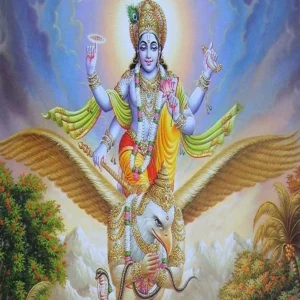
As Garuda began his return journey, Lord Vishnu appeared before him. Impressed by Garuda’s strength and selflessness—especially his lack of desire to consume the nectar himself—Vishnu granted him immortality. In return, Garuda offered Vishnu a boon, and the deity chose Garuda as his eternal mount.
Indra, the king of the gods, also encountered Garuda and granted him the ability to feed on serpents. In exchange, Garuda promised that the Amrit would ultimately be returned.
Clever Strategy Prevents Serpents from Gaining Amrit
Garuda delivered the nectar to the serpents as promised, placing it on the ground. However, he advised them to purify themselves before consuming it. While the serpents went to bathe, Indra swiftly reclaimed the Amrit.
A few drops fell onto the grass during the process. The serpents rushed back and tried to lick the droplets, but they gained nothing. Instead, their tongues split as a result, a trait still associated with snakes today.
A Story of Duty and Wisdom
In the end, Garuda fulfilled his promise, freed his mother, and upheld his integrity. The serpents, despite their cunning, were left without the nectar. This ancient tale continues to be remembered for its lessons on patience, intelligence, and the power of righteous intent.