Mythology – The complex legacy and origins of Ravana in ancient texts
Mythology – Ravana, widely remembered as the ruler of Lanka and a symbol of arrogance and wrongdoing, occupies a far more layered place in ancient Indian literature than commonly perceived. While many associate him with negative traits such as pride, anger, and injustice, traditional accounts also describe him as a deeply learned and spiritually accomplished figure.
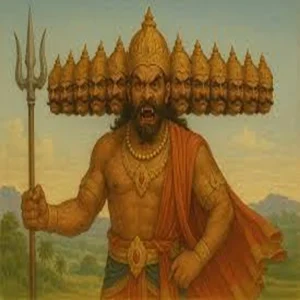
A Scholar Beyond His Reputation
Despite his portrayal as a formidable antagonist, Ravana is often described in scriptures as a highly educated individual. He possessed deep knowledge of the Vedas and sacred texts and was known for his devotion to Lord Shiva. His expertise extended to astrology, rituals, and esoteric sciences, reflecting a mind trained in both intellectual and spiritual disciplines. These qualities suggest that his personality was not limited to the image of a tyrant but included traits of a scholar and devotee.
Different Accounts of His Birth
Ancient texts offer varying explanations for Ravana’s origin. According to the epic Ramayana attributed to Valmiki, Ravana was the grandson of sage Pulastya and the son of Vishrava. Vishrava had two wives, and Ravana was born to Kaikesi. Some interpretations suggest that the circumstances surrounding his birth influenced his temperament, leading to his fierce and dominant nature.
Other texts, including the Bhagavata Purana and Padma Purana, connect Ravana’s birth to a broader cycle of rebirth. In these accounts, powerful beings were reborn across different eras, taking forms that shaped major events in mythological history.
The Curse That Shaped Destiny
One widely narrated story links Ravana’s birth to a divine curse. It is said that gatekeepers of Lord Vishnu, named Jaya and Vijaya, once denied entry to revered sages seeking an audience. Offended by this act, the sages cursed them to be born as demons. After seeking forgiveness, the severity of the curse was reduced, but they were destined to be reborn three times in demonic forms and ultimately be defeated by Vishnu or his incarnations.
In their first birth, they appeared as Hiranyaksha and Hiranyakashipu. Both were powerful and posed significant challenges to cosmic balance. Vishnu, in his Varaha and Narasimha incarnations, defeated them to restore order.
Rebirth Across Yugas
In the Treta Yuga, the same souls are believed to have been born as Ravana and his brother Kumbhakarna. Their strength and influence again disrupted harmony, leading to their eventual defeat. Later, in the Dvapara Yuga, they were reborn as Shishupala and Dantavakra, continuing the cycle until the curse was fulfilled.
This recurring pattern highlights a philosophical theme found in many ancient narratives—that actions, consequences, and redemption unfold across multiple lifetimes.
Why Ravana Was Called Dashanan
Ravana is often referred to as Dashanan, meaning “the one with ten heads.” This name is derived from his title Dashagriva. According to tradition, Ravana performed intense penance to please Lord Shiva and, as a result, was granted immense power symbolized by ten heads.
These ten heads are sometimes interpreted symbolically, representing vast knowledge or mastery over different domains. However, in the Ramayana, they are described more literally, and during the battle with Lord Rama, each of these heads was severed one by one.
A Legacy of Contradictions
Ravana’s story continues to be discussed not only for his role in epic conflicts but also for the contrast between his wisdom and his choices. Many interpretations suggest that had he used his knowledge for constructive purposes, his legacy might have been remembered very differently.
Instead, his life stands as a reminder that intellectual brilliance alone does not define greatness. The direction in which knowledge is applied ultimately shapes how history remembers an individual.