Mythology – The Legend of Narasimha and Hiranyakashipu’s Defeat
Mythology – The tale begins with Sage Kashyapa and his wife Diti, who were blessed with two sons, Hiranyaksha and Hiranyakashipu. Both brothers were powerful beings, but their destinies unfolded in very different ways. Hiranyaksha was eventually killed by Lord Vishnu, who took the Varaha incarnation to rescue the Earth. This event deeply affected Hiranyakashipu, filling him with grief and a burning desire for revenge.
Hiranyakashipu’s Quest for Invincibility
Determined to avenge his brother’s death, Hiranyakashipu undertook intense penance that lasted for thousands of years. His unwavering dedication pleased Lord Brahma, who granted him a unique boon. The conditions of this blessing were carefully crafted: he could not be killed indoors or outdoors, neither by weapons nor by living beings classified as human or animal. He would not meet his end during the day or at night, nor on the ground or in the sky.
Armed with what he believed was near immortality, Hiranyakashipu grew increasingly powerful. He conquered the heavens, drove away the guardians of the universe, and declared himself supreme ruler. The gods found themselves helpless, unable to challenge his dominance.
Rise of Devotion in Prahlada
Despite his father’s arrogance and cruelty, Hiranyakashipu’s son Prahlada became a devoted follower of Lord Vishnu. This unwavering faith angered Hiranyakashipu, who saw it as defiance. He made several attempts to kill Prahlada, but each effort failed due to divine protection.
Prahlada’s devotion symbolized the triumph of faith over fear. His belief remained unshaken even in the face of repeated threats to his life. This contrast between father and son set the stage for a dramatic turning point.
The Narasimha Avatar Appears
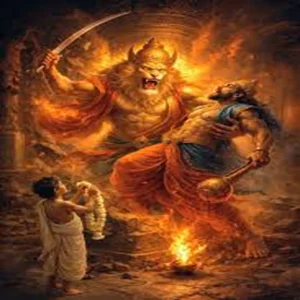
To protect Prahlada and restore balance, Lord Vishnu took the form of Narasimha, a being that was neither human nor animal. At twilight, a time that was neither day nor night, Narasimha confronted Hiranyakashipu at the threshold of a doorway, which was neither inside nor outside.
In a moment that fulfilled every condition of the boon, Narasimha placed Hiranyakashipu on his lap—neither ground nor sky—and killed him using his claws, not traditional weapons. This marked the end of the tyrant’s reign and the victory of righteousness.
Uncontrolled Fury of Narasimha
However, the story did not end with Hiranyakashipu’s death. Narasimha’s anger did not subside, and his fierce form threatened the stability of the universe. Even Prahlada, whose devotion had brought forth the avatar, was unable to calm him.
Frightened by this overwhelming rage, the gods turned to Lord Brahma for guidance. Brahma, along with other deities, approached Lord Vishnu, but he expressed his inability to pacify the Narasimha form. He then suggested seeking the help of Lord Shiva.
Shiva’s Intervention in a Unique Form
Responding to the gods’ plea, Lord Shiva appeared before Narasimha. However, even his presence did not immediately calm the enraged avatar. In response, Shiva assumed a powerful form known as Sharabha or a fierce bull-like manifestation.
In this form, Shiva subdued Narasimha by wrapping him in his tail and restraining him. Despite his immense strength, Narasimha could not break free. Gradually, as the intensity of the confrontation diminished, Narasimha recognized Shiva and his anger faded.
Restoration of Balance
At the request of Brahma and Vishnu, Shiva released Narasimha once calm was restored. This moment symbolized harmony between divine forces and the restoration of cosmic balance. The gods, along with Prahlada, witnessed the presence of two powerful divine manifestations.
The story remains an enduring reminder of the limits of power, the strength of devotion, and the importance of balance in the universe. It also highlights how divine intervention often comes in unexpected forms to uphold justice