Pilgrimage – Ancient Legends Behind Badrinath and Goddess Lakshmi’s Sacred Form
Pilgrimage – Badrinath Dham holds a unique place in Hindu beliefs and ancient scriptures. The temple, counted among the Char Dham pilgrimage sites, is deeply connected with Lord Vishnu and Goddess Lakshmi through several mythological stories mentioned in religious texts and oral traditions.
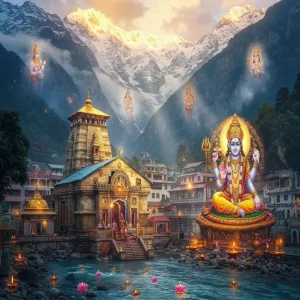
Goddess Lakshmi’s Role in Protecting Lord Vishnu
According to references found in the Skanda Purana, Lord Vishnu once entered deep meditation in the Himalayan region. During this period, the area witnessed intense snowfall, and the deity became completely covered in snow. Seeing this condition, Goddess Lakshmi is believed to have taken steps to shield Lord Vishnu from harsh weather conditions, including snow, rain, and strong sunlight.
Religious stories say that when Goddess Lakshmi could no longer bear to watch Lord Vishnu endure the severe climate, she transformed herself into a Badri tree, commonly associated with the jujube or berry tree. In this form, she protected Lord Vishnu throughout his long meditation in the mountains.
How the Name Badrinath Originated
It is believed that after many years, Lord Vishnu emerged from meditation and saw Goddess Lakshmi standing nearby in the form of the Badri tree, entirely covered in snow. Moved by her devotion and sacrifice, Lord Vishnu is said to have praised her dedication and declared that the sacred place would forever be associated with her name and presence.
From that moment, the deity came to be known as “Badrinath,” meaning the Lord of Badri. Religious followers consider this story one of the central legends connected with the holy shrine in Uttarakhand.
Ancient scriptures also describe the spiritual importance of Badrinath by stating that while countless pilgrimage sites exist across heaven, earth, and the underworld, none can equal the sanctity of Badrinath.
Beliefs Linked to the Badrinath Pilgrimage
Among devotees, a well-known saying associated with Badrinath suggests that a person who visits the shrine attains liberation from the cycle of rebirth. Though rooted in faith and tradition, this belief has been repeated for generations by pilgrims traveling to the Himalayan temple.
Religious texts further mention that every individual should undertake the Badrinath pilgrimage at least twice in their lifetime. For many devotees, the journey is considered not only spiritually rewarding but also a path toward inner peace and devotion.
The Legend Connecting Vishnu, Shiva and Parvati
Another popular story linked to Badrinath comes from ancient folklore related to Lord Vishnu, Lord Shiva, and Goddess Parvati. According to this belief, during the Satya Yuga, the region around Badrinath was filled with forests of Badri trees. At that time, Lord Shiva and Goddess Parvati are believed to have lived peacefully in the area.
One day, Lord Vishnu reportedly arrived there in the form of a crying child. Hearing the child’s cries echo through the dense forest, Goddess Parvati became concerned and wondered who the child was and how he had reached such a remote place alone.
Out of compassion, she brought the child to her home despite Lord Shiva sensing that the child was actually Lord Vishnu in disguise. Shiva advised her to leave the child outside, believing it to be part of a divine act, but Goddess Parvati chose to care for the child instead.
The Spiritual Separation of Kedarnath and Badrinath
According to the legend, once Goddess Parvati and Lord Shiva stepped outside for a short walk, Lord Vishnu closed the door from inside after awakening from sleep. When Shiva and Parvati returned and asked the child to open the door, Lord Vishnu revealed his true form and expressed his wish to remain there permanently.
The story further states that Lord Shiva then moved toward Kedarnath, while Lord Vishnu stayed at Badrinath to bless devotees. Since then, both pilgrimage sites have remained deeply connected in Hindu tradition and continue to attract millions of worshippers every year.