Pilgrimage – Ganga Saptami Highlights Sacred Legends Behind River Ganga
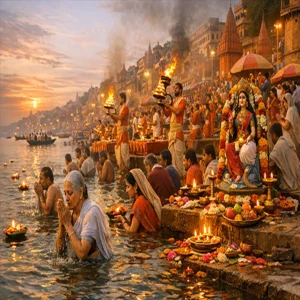
Pilgrimage – Ganga Saptami is observed every year on the seventh day of the bright fortnight of the Vaishakh month and holds a special place in Hindu religious traditions. According to ancient scriptures, this is the day when Goddess Ganga reached the matted locks of Lord Shiva from the heavenly realm. The occasion is dedicated to worshipping the sacred river, which is revered by millions across India. While Ganga Jayanti marks the divine appearance of Goddess Ganga, Ganga Dussehra commemorates her descent to Earth during the month of Jyeshtha.
Why Ganga Is Revered Beyond a River
In Indian culture, rivers are not viewed merely as water bodies. They are regarded as life-giving forces that sustain agriculture, communities, and civilizations. Because of this deep connection with human life, many rivers are worshipped in the form of goddesses. The Ganga, in particular, occupies a unique position as both a sacred river and a divine entity in Hindu belief.
Ancient texts and Puranas contain numerous stories describing her origin, significance, and relationship with various deities. These narratives have been passed down through generations and continue to shape religious traditions across the country.
Different Accounts of Ganga’s Origin
Several legends explain the birth of Goddess Ganga. One tradition describes her as the daughter of the Himalayas, making her the sister of Goddess Parvati. Another account states that she emerged from the sacred water stored in Lord Brahma’s kamandalu. Some scriptures further mention that the river originated after Lord Brahma collected water used to wash the feet of Lord Vishnu, earning Ganga the title Vishnupadi.
Other texts identify her as the daughter of King Himavan and Queen Mena. Variations in these stories reflect the rich diversity of Hindu mythology while emphasizing Ganga’s divine status.
King Bhagiratha and Ganga’s Descent to Earth
Among the most well-known legends is the story of King Bhagiratha, an ancestor of Lord Rama. Determined to bring the celestial river to Earth for the salvation of his ancestors, Bhagiratha performed intense penance. Pleased by his devotion, Lord Brahma agreed to send Ganga to Earth.
However, concerns arose regarding the force of the river’s descent. It was believed that only Lord Shiva possessed the strength to control her powerful flow. After further prayers, Shiva accepted the task and captured Ganga within his matted hair before gradually releasing her streams onto Earth. This event is regarded as one of the most significant episodes associated with the sacred river.
Ganga’s Place in Hindu Mythology
Many scriptures describe a close association between Ganga, Shiva, and Parvati. Some traditions state that Lord Shiva accepted Ganga as a divine consort. Mythological accounts also connect her to Lord Kartikeya, with certain texts referring to her as his foster mother.
Another popular legend relates to Lord Ganesha. According to religious narratives, Ganga’s sacred waters played a role in restoring life to him, leading some traditions to honor her as one of his maternal figures. These stories further strengthen her revered position within Hindu belief systems.
The Story of King Shantanu and Bhishma
A separate legend links Ganga with King Shantanu of the Kuru dynasty. Ancient texts narrate that in a previous birth, King Mahabhisha and Ganga were cursed by Lord Brahma after becoming captivated by one another in his presence. They later took birth on Earth and eventually reunited.
Ganga married King Shantanu and gave birth to eight sons. According to the legend, seven of them were immersed in the river soon after birth due to a divine vow. The eighth child survived and was raised as Devavrata, who later became famous in the Mahabharata as Bhishma, one of the epic’s most respected and influential characters.