Ganga Jayanti – Legends Behind Goddess Ganga’s Descent and Earthly Journey
Ganga Jayanti – Hindu scriptures describe several fascinating stories connected to Goddess Ganga, her divine origin, and her journey from heaven to Earth. These narratives continue to hold deep spiritual significance for millions of devotees across India.
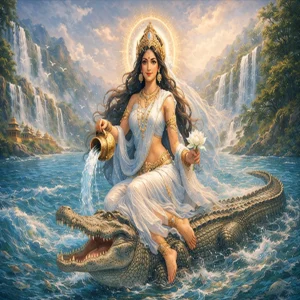
Ganga Jayanti is observed every year on the seventh day of Shukla Paksha in the month of Vaishakh. This year, the occasion was celebrated on May 18. Hindu religious texts and Puranas contain multiple accounts about the birth of Goddess Ganga and the circumstances that brought the sacred river to Earth. Alongside her spiritual importance, several ancient stories also describe her emotional and human connections, including her marriage to King Shantanu.
Origin of Goddess Ganga in Hindu Scriptures
According to the Vamana Purana, the story of Ganga begins during Lord Vishnu’s Vamana incarnation. When Vishnu expanded his form and raised one foot toward the heavens, Lord Brahma washed his feet with holy water and collected it in his kamandalu. It is believed that the divine energy from this sacred water gave birth to Goddess Ganga.
Later, Brahma entrusted Ganga to the Himalayas, making her spiritually connected to Goddess Parvati as a sister figure. Another version of the legend states that when Vamana’s foot pierced the sky, three streams of water emerged. One flowed through heaven, another reached Earth, and the third entered the netherworld. Because of this threefold journey, Ganga became known as “Tripathaga,” meaning the river that travels through three realms.
Connection Between Lord Shiva and Ganga
The Shiva Purana presents another well-known legend linked to Goddess Ganga. The scripture mentions that Ganga wished to have Lord Shiva as her husband, similar to Goddess Parvati. However, Parvati was not pleased with this desire. Despite the tension, Ganga performed intense penance to seek Shiva’s blessings.
Pleased by her devotion, Lord Shiva granted her a place with him. This blessing later became significant when Ganga descended to Earth with tremendous force. To prevent destruction and floods across the planet, Shiva captured the river in his matted hair before gently releasing her flow onto Earth. This episode remains one of the most iconic moments associated with the sacred river in Hindu belief.
Folk Traditions and Regional Narratives
Several regional traditions, especially Marathi folk tales, also narrate stories related to Ganga and Shiva. In some versions, Ganga is described as Shiva’s second wife, leading to conflict with Parvati. These stories often portray Shiva protecting Ganga from Parvati’s anger by hiding her within his locks.
Such narratives highlight how deeply rooted the river goddess is in Indian cultural traditions. Across different regions, the stories may vary slightly, but Ganga’s role as a symbol of purity, devotion, and compassion remains unchanged.
Story of Ganga and King Shantanu
Ancient texts also describe Goddess Ganga’s human form and her marriage to King Shantanu of Hastinapur. According to mythology, both Ganga and King Mahabhish were cursed by Lord Brahma and sent to Earth. Mahabhish was reborn as King Shantanu.
One day, while hunting near the banks of the Ganga river, Shantanu encountered Ganga in human form. The two eventually fell in love and married. They had eight sons together. However, after the birth of each of the first seven children, Ganga immersed them in the river.
The eighth child survived and later became Devavrata, who was famously known as Bhishma in the Mahabharata. Mythological accounts explain that the eight children were incarnations of the Vasus, celestial beings cursed to be born on Earth. By immersing them in the river, Ganga was helping them attain liberation from the curse.
The Curse That Changed Their Destiny
The Mahabharata further explains that Ganga once visited Indra’s celestial court along with Lord Brahma. King Mahabhish was also present there. During a gathering, a sudden gust of wind displaced Ganga’s garment. While the other gods respectfully lowered their eyes, Mahabhish continued looking at her, and Ganga also remained focused on him.
Angered by this behavior, Brahma cursed both of them to take birth on Earth. However, he also declared that their bond would continue in mortal life, eventually leading to their union as Shantanu and Ganga.